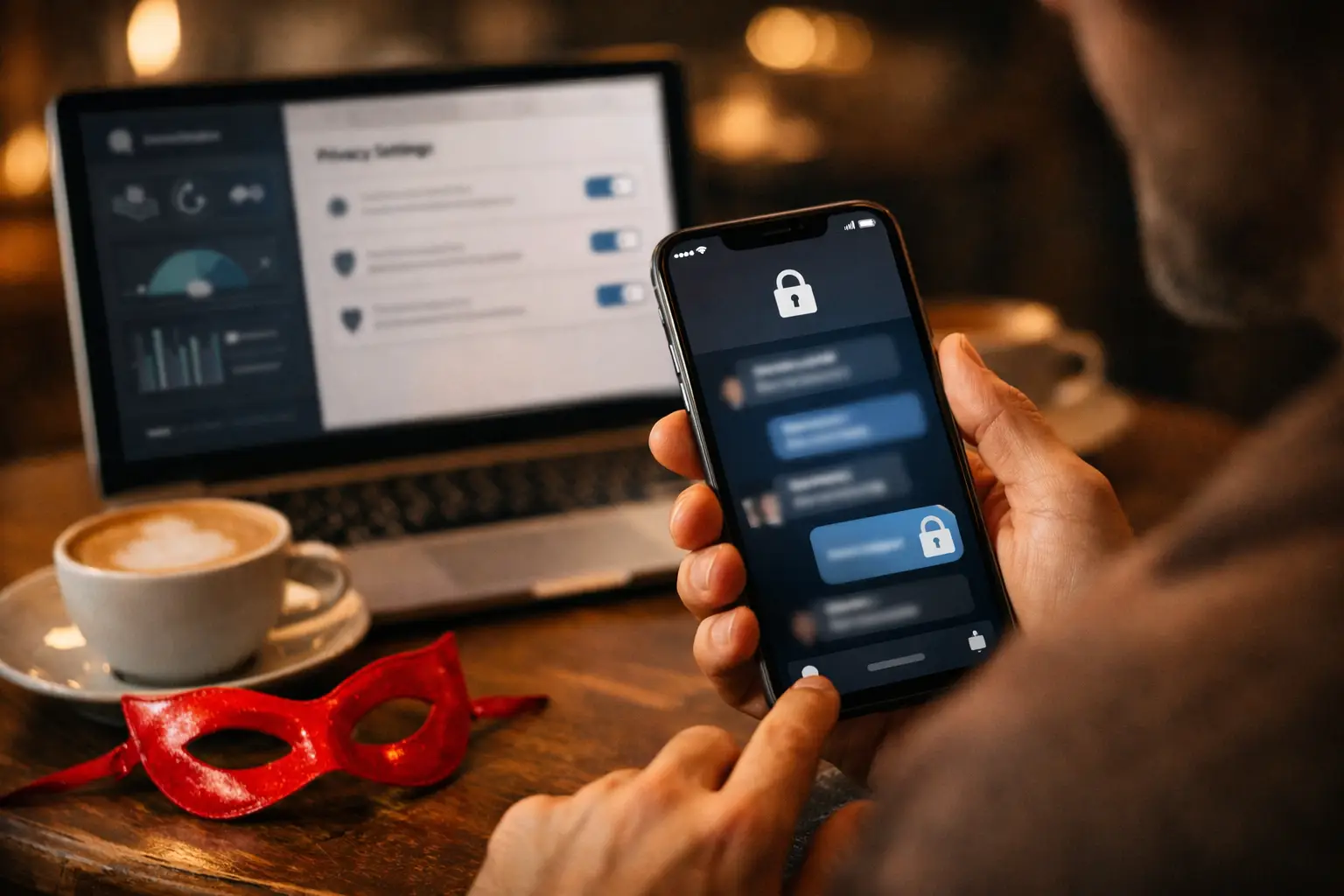
A revealing message can feel harmless while you are sending it, then become a source of stress when it appears on a lock screen, lands with the wrong person, or stays accessible long after a connection ends. For adults exploring swinging, open relationships, or other forms of ethical non-monogamy, the answer to what makes dating messages private goes well beyond a chat window that says “private.” It comes down to how the conversation is encrypted, who can access it, what identifying details are exposed, and whether the people on the other side are real.
Privacy is not a single setting. It is a system of technical protections, thoughtful platform design, and personal judgment. A good adult social platform should support all three without asking members to trade discretion for connection.
What Makes Dating Messages Private at the Technical Level
The strongest protection for a direct message is end-to-end encryption. This means a message is encrypted on the sender’s device and can be decrypted only on the intended recipient’s device. The service carrying the message should not be able to read the conversation content in transit or from its own servers.
That distinction matters. A platform may use encryption to protect data moving between your phone and its servers, but that is not the same as end-to-end encryption. With standard transport encryption, the platform can potentially access the message after it arrives. With true end-to-end encryption, the content remains unreadable to anyone outside the conversation, including the platform.
Aphrodite uses end-to-end encrypted direct messaging built on the Signal protocol, a widely respected approach to private communication. This is meaningful because privacy should not depend on a company simply promising to be discreet. It should be designed into how messages are handled.
Encryption protects message content, but it has limits. It cannot stop a recipient from taking a screenshot, copying text, or showing a conversation to someone else. It also does not erase the need to protect the device where messages are received. Strong privacy technology gives you a protected channel. It does not remove the need for trust and boundaries.
Message Content Is Only One Part of Privacy
Private messaging is often discussed as if the words and photos inside a chat are the only sensitive information. They are not. Information around a conversation can be revealing too, including names, profile photos, location clues, notification previews, and activity indicators.
A privacy-first experience reduces unnecessary exposure before a conversation even starts. Blurred profile photos for people who are not connections, obscured geolocation, and hidden personal identifiers make it harder for a casual browser to tie a lifestyle profile to someone’s offline identity. These details are especially valuable for members who want to be open within the community without being discoverable outside it.
Location deserves particular care. Even a neighborhood-level display can narrow down where someone lives, works, or spends time. Manual location settings give members more control over what they share and when. For travel, events, or a new connection, that control can make the difference between feeling comfortable and feeling overexposed.
Private Dating Messages Start With Real People
Encryption protects a conversation from outside access. Verification helps protect it from deception inside the conversation.
Fake profiles create a privacy risk that is easy to underestimate. A person who is not who they claim to be may be collecting photos, personal details, contact information, or evidence of someone’s participation in the lifestyle. They may also use a convincing profile to pressure members into moving conversations off-platform before trust has been established.
Multi-tier identity verification changes the quality of the interaction. It gives members stronger signals that the person or couple behind a profile is genuine, while allowing the community to maintain discretion. Verification is not a guarantee that every interaction will be compatible or respectful. It does, however, make impersonation and low-effort deception more difficult.
For couples, authenticity also includes clarity about who is participating. A platform designed for couples should recognize that two adults may share a profile while each needs independent access. Dual-login couple accounts support that practical reality. They reduce the awkward workarounds that can lead to shared passwords, unclear account ownership, or missed conversations.
Privacy within a relationship still requires an agreement. Partners should discuss who handles messages, whether either person can initiate conversations independently, what details are okay to share, and when a new connection should be brought into the conversation. Technology can support those choices, but it cannot make them for you.
Privacy Controls Should Match the Pace of Trust
The safest way to share is usually in stages. Early messages do not need a full name, workplace, home area, personal phone number, or social media account. A well-designed profile can communicate interests, boundaries, and intentions without exposing the details that identify someone offline.
This is where customizable visibility settings matter. Members should be able to choose what different audiences can see, rather than treating a profile as all public or all hidden. Photo galleries, videos, personal descriptions, and lifestyle preferences can help establish compatibility, but they should be shared at a pace that feels right for the people involved.
The same principle applies to messaging. Start with what is necessary to establish basic alignment: what you are looking for, whether you are dating as a couple or individually, your boundaries, and your expectations for communication. As interest becomes mutual and behavior remains consistent, more personal information can be exchanged deliberately.
There is a trade-off. Restricting every detail may make it harder to form a genuine connection, while sharing too much too quickly can create unnecessary risk. The goal is not to make yourself unknowable. It is to keep control of your identity until trust has been earned.
The Device Can Be the Weakest Link
A fully encrypted chat is still visible to anyone who can open your phone, tablet, or computer. For privacy-conscious members, device habits are part of the messaging strategy.
Use a strong device passcode rather than an easily guessed pattern, and keep your operating system current. Review lock-screen notifications so message previews do not display names or sensitive content where others can see them. Log out of shared or public devices, and do not save credentials in browsers that other people can access.
Consider the practical realities of your household, travel, and work environment. If you share a tablet with family members, use separate device profiles where available. If you are messaging while traveling, avoid leaving an unlocked device unattended. If you receive messages on a work-managed device, assume your employer may have administrative visibility and keep adult social conversations on your personal device.
These steps are not about secrecy from a partner. In ethical non-monogamy, privacy and transparency can coexist. Privacy protects each person from unwanted exposure. Transparency means partners have clear, mutually agreed expectations about their connection and communication.
Boundaries Make Private Conversations Safer
A private platform cannot compensate for a conversation that ignores boundaries. Before sharing intimate photos, identifying details, or plans to meet, pay attention to how the other person responds to simple limits. Respectful members accept a “not yet,” do not pressure you to leave the platform immediately, and do not treat verification or privacy preferences as an insult.
A few direct questions can reveal a great deal: Are they comfortable discussing boundaries? Do they understand that a couple may need time to decide together? Are they willing to keep communication on the platform until everyone is comfortable? Do their words match the information on their profile?
If something feels off, it is reasonable to slow down, stop responding, or use available blocking and reporting tools. You do not owe a stranger a detailed explanation for protecting your privacy. A credible community depends on members being able to set limits without being punished for them.
Privacy Should Feel Built In, Not Hidden
The best private dating messages are not created by making members hunt through complicated settings after something goes wrong. They come from an environment where encrypted communication, identity verification, controlled profile visibility, and respectful community expectations work together from the start.
That design gives adults room to explore connection without treating discretion as an afterthought. Share what supports the connection, keep control of what identifies you, and let consistent respect determine what comes next.