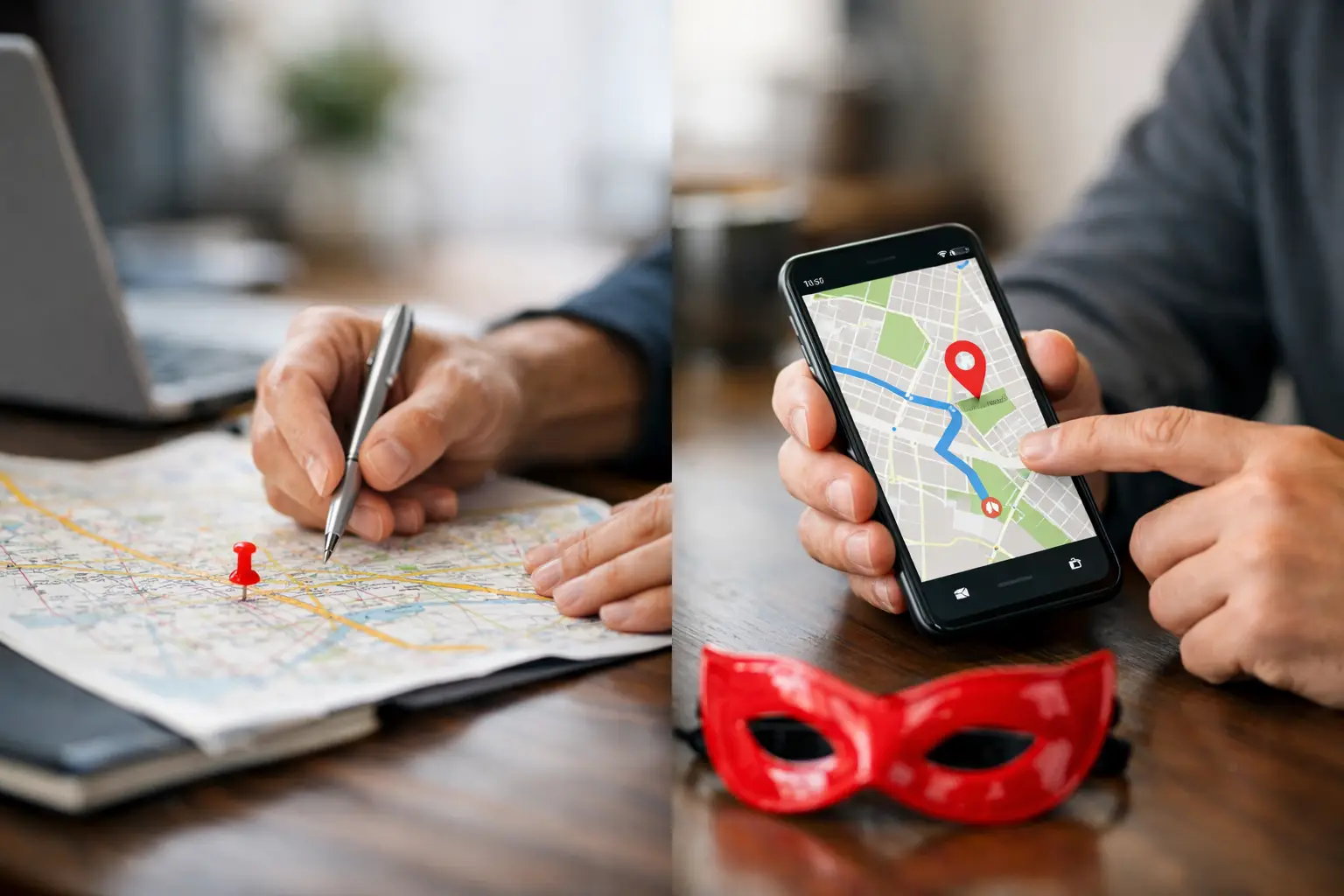
A manual location versus live location choice is really a choice about context. One tells people the area you choose to share. The other can show where you are as you move. For lifestyle members arranging a club visit, a party, or a first coffee before a get-together, those are very different levels of disclosure.
Neither option is automatically better. Manual location is usually the more private default. Live location can be useful when it is temporary, expected, and shared only with people you already trust. The right choice depends on the plan, the people involved, and how much precision is actually necessary.
What is a manual location?
A manual location is a place you set yourself rather than a continuously updated GPS position. It may be a city, a neighborhood, or another broad area, depending on the service. It remains in place until you change it.
For example, someone planning a weekend in Amsterdam might set their location to Amsterdam before the trip. A couple visiting a club outside Barcelona could list Barcelona or the surrounding area rather than the club's exact address. That gives other members enough context to start a conversation without revealing a hotel, home, workplace, or route.
Manual location is also useful when the purpose is discovery rather than immediate logistics. If you want to find clubs, parties, groups, or compatible members in a city, a broad location is normally more useful than a moving dot on a map. It answers the practical question: where are you looking to connect?
There is a trade-off. Because it is self-set, manual location may be out of date. A profile can say Paris while the person is traveling, has moved, or simply has not changed the setting. Treat it as general context, not proof that somebody is nearby at that moment.
What is live location?
Live location uses a device's current position and updates it while sharing remains active. Depending on the settings, it may show an approximate or more precise location. It is designed for coordination in the moment, not for maintaining a standing profile location.
Its best use is narrow and time-limited. Perhaps two people have agreed to meet at a large venue and need help finding the right entrance. Perhaps friends traveling separately to an approved get-together want to confirm they have arrived safely. In those cases, a live location can reduce back-and-forth messages.
It also creates more exposure. A live location may reveal patterns that a city label does not: where someone started, how long they stayed, which route they took, or whether they are still at a venue. That information can be more personal than people realize, especially for members whose careers, families, or local community make discretion non-negotiable.
For that reason, live location should never be treated as a requirement for trust. A person can be interested, genuine, and considerate without sharing their real-time position. Consent applies to location data as much as it applies to any other part of a plan.
Manual location versus live location: the practical difference
The main difference is not technical. It is how much information continues to leave your device after you share it.
A manual location is a statement: “I am open to meeting people in this area.” It is broad, stable, and easy to reconsider. It works well for browsing a member directory, discussing a future trip, or deciding whether a club or party is within reach.
A live location is an ongoing signal: “This is where I am right now.” It can be helpful for a specific plan, but it needs a clear beginning and end. It should be shared with a defined person or group, for a defined reason, and turned off once that reason has passed.
That distinction matters for couples. One partner may be arriving earlier, parking elsewhere, or leaving at a different time. A shared profile does not mean each partner has identical boundaries around location. Talk about the plan before sharing anything. Decide who shares, with whom, how precise it needs to be, and when it stops.
When should you use a manual location?
Use a manual location when you want to be findable without being trackable. It is usually the stronger choice for profile visibility, social discovery, and conversations that are still at an early stage.
It makes sense when you are researching a city before traveling, looking for an event in your region, or getting familiar with the lifestyle community in a new area. It also makes sense when you want to keep a clear boundary between your private life and your social plans. A city or broad area gives enough detail for relevant conversation without making your daily movements part of the conversation.
Be deliberate about the level of detail. “Berlin” may be sufficient. “Near Berlin” may be better if you live outside the city and prefer not to narrow things down. If a platform offers a location radius or blurred location, consider whether that is more useful than naming a specific neighborhood.
On Aphrodite, location is blurred by default. That is designed to support local discovery while avoiding unnecessary precision. It does not remove the need for good judgment. Details shared in profile text, photos, or conversation can still build a clearer picture than intended. GPS data is stripped from uploaded media, but it is still wise to review what is visible in an image before posting it.
When can live location be appropriate?
Live location is most appropriate after a plan has become concrete and mutual. The people involved should already know where they are meeting and why real-time coordination would help.
A large club night is one example. You may agree to share a live location for the short walk from the parking area to the entrance. A crowded festival or city event is another. If several friends are meeting at an unfamiliar venue, a temporary location can help people regroup without publishing their movements to a wider audience.
Set a time boundary before you activate it. “I will share until we meet at the entrance” is clearer than “I will send my location.” If the plan changes, say so in a message. If you decide not to meet, turn sharing off and communicate that directly if it is appropriate to do so.
Do not use live location to pressure someone into proving they are on the way, at home, or at a particular venue. That turns a practical tool into a test. Clear communication is more reliable, and more respectful, than real-time tracking.
How can you share location without oversharing?
Start with the least precise option that still solves the problem. For an early conversation, a city is enough. For planning a club visit, the venue name or general area may be enough. For meeting at a busy location, a named entrance, a time, and a recognizable public landmark can often replace live tracking altogether.
If you do choose live location, check four things before sharing: the recipient, the accuracy, the duration, and the stop point. Send it only to the person or small group who needs it. Use the broadest precision available if exact coordinates are unnecessary. Set the shortest practical time window. Then verify that sharing has ended after the meeting.
It also helps to separate arrival coordination from private space. Sharing a location to find a public venue does not mean sharing a hotel, home, or next destination. You can keep those boundaries without making the interaction awkward. A simple “We will meet you at the lobby bar at 9” or “We are heading out now, see you inside” is often all that is needed.
Location sharing should follow consent and context
Location settings are not a measure of openness, interest, or honesty. They are a boundary. A manual location can support discovery while preserving discretion. A live location can support a specific plan when everyone involved has agreed to it.
The useful question is not whether real-time sharing is available. It is whether it adds enough value to justify the extra detail. For most early conversations and general lifestyle discovery, a manual location is enough. Save live location for the moments when it genuinely helps people find each other, then let it end with the plan.