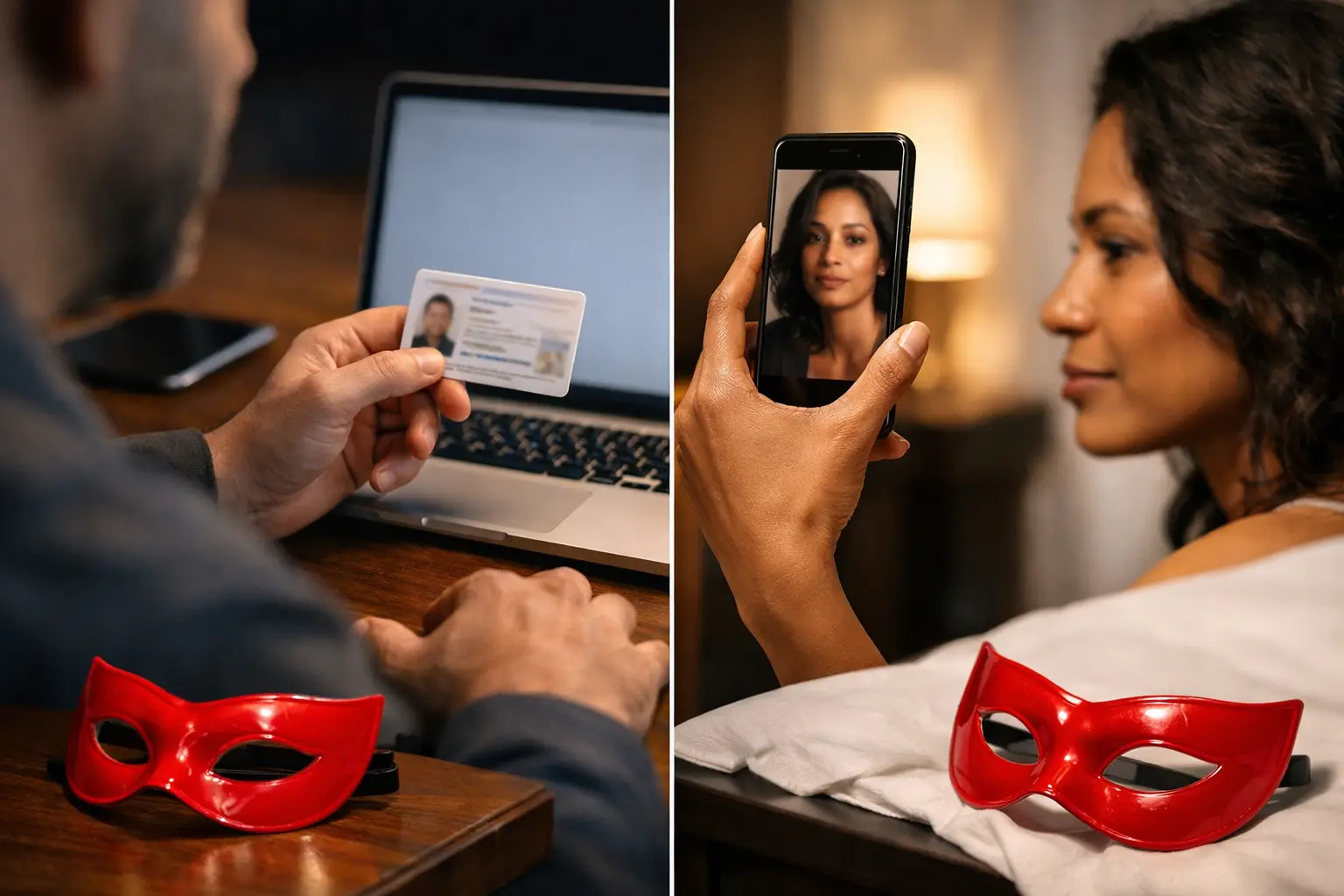
A profile can have polished photos, a thoughtful bio, and all the right preferences - then still belong to someone other than the person behind the screen. That is why the distinction between identity checks versus photo verification matters on an adult social platform. They address different risks, and neither should be treated as a blanket promise that every connection will be right, safe, or compatible.
For people exploring swinging, open relationships, or other forms of ethical non-monogamy, trust is not a minor feature. It affects whether you feel comfortable sharing a face photo, starting a private conversation, or considering an event invitation. The best approach is layered: confirm authenticity while collecting only the information needed to do so.
Identity Checks Versus Photo Verification: The Core Difference
Photo verification usually asks a member to take a current selfie or short live capture. The system compares that image with photos already displayed on the profile, often using prompts intended to show that the capture is recent and performed by a real person rather than uploaded from someone else's gallery.
Its question is straightforward: Does this person appear to be the person in these profile pictures? This can reduce common forms of deception, such as stolen images, impersonation, and accounts built from pictures copied from elsewhere. It is particularly useful in communities where members may reasonably choose to blur public profile photos until there is a mutual connection.
Identity verification goes further. It may involve confirming a government-issued document, checking personal details against trusted sources, or pairing a document check with a live facial capture. Its question is more substantial: Can this account be tied to a real, unique person using credible evidence?
That added certainty can help limit duplicate accounts, repeat bad actors, and people who create a profile with a believable face but a false name or background. It also creates stronger accountability when a platform needs to investigate a report.
Still, an identity check does not mean a person has good intentions. A verified member can be a poor match, ignore a boundary, or misrepresent what they want from a connection. Verification establishes a foundation for trust. Respectful behavior, clear communication, and consent build on top of it.
What Photo Verification Does Well
Photo verification is often the lower-friction option. It can give members a meaningful signal before they reveal more sensitive information, which matters for people managing career, family, and social privacy alongside their lifestyle interests.
It is especially valuable when your immediate concern is visual authenticity. If someone says they are a couple but only one person ever appears in current, consistent photos, photo verification can help clarify part of the picture. It may also reduce uncertainty before moving from profile browsing to encrypted messaging.
For many users, it feels proportionate. They want confirmation that the photos are genuine without submitting documents that include their legal name, home address, or other identifying details. A privacy-conscious platform should recognize that this hesitation is reasonable, not suspicious.
Photo verification also has limits. A person can be real and still use selective, old, or incomplete photos. A verified selfie cannot establish relationship status, confirm that both partners actively consent to a couple profile, or tell you whether the person will honor your stated boundaries.
What Identity Checks Add
Identity checks are designed for higher-stakes assurance. They make it harder for one individual to operate multiple convincing accounts or return under a new identity after serious misconduct. Where a platform offers multiple verification levels, an identity-based tier can give members more context when deciding how much to share and how quickly to engage.
The benefit is not simply that a document was reviewed. It is that the platform can connect an account to a stronger evidence trail while keeping that evidence protected. On a well-designed adult network, verification data should not become a public profile field. Other members need a clear verification signal, not access to your legal identity.
This distinction is vital. A visible badge can communicate that a platform has completed a check. It should not expose your full name, document image, birth date, address, or the fact that you participate in an adult community.
Identity verification does require a greater privacy trade-off. Some members will be comfortable with it, particularly if they attend private events or prefer higher-accountability connections. Others will reasonably choose a less intensive option. A thoughtful system provides choices, explains what each tier means, and does not pressure people into sharing more than the community purpose requires.
Why Couples Need More Than a Single Check
Couple profiles create a distinct trust question: are both people aware of, participating in, and able to access the account? A single verification performed by one partner may confirm one real person, but it does not automatically establish shared participation.
This is where account design matters as much as verification. Independent access for each partner reduces the chance that one person is managing a supposedly mutual profile without the other's knowledge. It also supports healthier communication when both partners can review messages, preferences, and plans on their own terms.
When connecting with a couple, look for consistency rather than trying to extract private proof. Are preferences written clearly? Do both partners appear involved in conversation? Do their stated boundaries remain consistent when details are discussed? A verification status can inform your judgment, but it should never replace it.
Privacy Is Part of Trust, Not an Obstacle to It
There is a false choice that appears often in adult dating: either reveal everything to prove you are real, or stay anonymous and accept that nobody can trust you. Strong platforms reject that choice.
A better model separates verification from exposure. The platform can confirm information privately while members decide what to show publicly. Blurred photos for people outside your connections, obscured location details, customizable gallery visibility, and private messaging help prevent a verification process from becoming an unwanted disclosure.
Aphrodite.is is built around this kind of layered approach, pairing identity verification options with privacy controls and independent dual-login access for couple accounts. The aim is not to make members more visible than they choose to be. It is to make genuine participation easier to recognize.
Data handling deserves the same scrutiny as the verification method itself. Before completing any check, consider whether the platform explains why information is collected, how it is protected, who can access it, and whether it is displayed to other members. Vague answers are a reason to pause.
Use Verification Signals Wisely
Verification is most useful when it informs a broader decision, rather than ending it. Before taking a conversation off-platform, sharing identifying details, or agreeing to meet, pay attention to the full pattern of interaction.
A credible profile should show more than a badge. Its photos, descriptions, preferences, and messages should generally align. The member should communicate directly about boundaries and respond respectfully when you set your own. For couples, both partners should have a clear opportunity to participate before expectations move forward.
If something feels inconsistent, slow down. Keep conversations in the platform's protected messaging environment, avoid sharing your last name or workplace early, and do not let urgency override your comfort level. Someone who is genuine and respectful will understand a measured pace.
The same applies after a good first impression. Verification may reduce uncertainty, but it cannot remove the need for clear plans, mutual consent, and the ability to change your mind. Trust is built through repeated, respectful choices.
Choosing the Right Level of Assurance
Photo verification may be enough when you want reassurance that a profile reflects a real, current person and you are still getting to know the community. Identity checks may make more sense when you want stronger accountability, are building longer-term connections, or prefer to engage primarily with members who have completed a higher level of review.
Neither choice is universally better. The right standard depends on what you are comfortable sharing, the type of connection you seek, and the platform's ability to protect the information it receives. What should remain non-negotiable is transparency: members deserve to know what a verification badge means, what it does not mean, and how their private data stays private.
The most reassuring connection is rarely the one that asks you to trust fastest. It is the one where authenticity, privacy, and respect all have room to develop at the same pace.