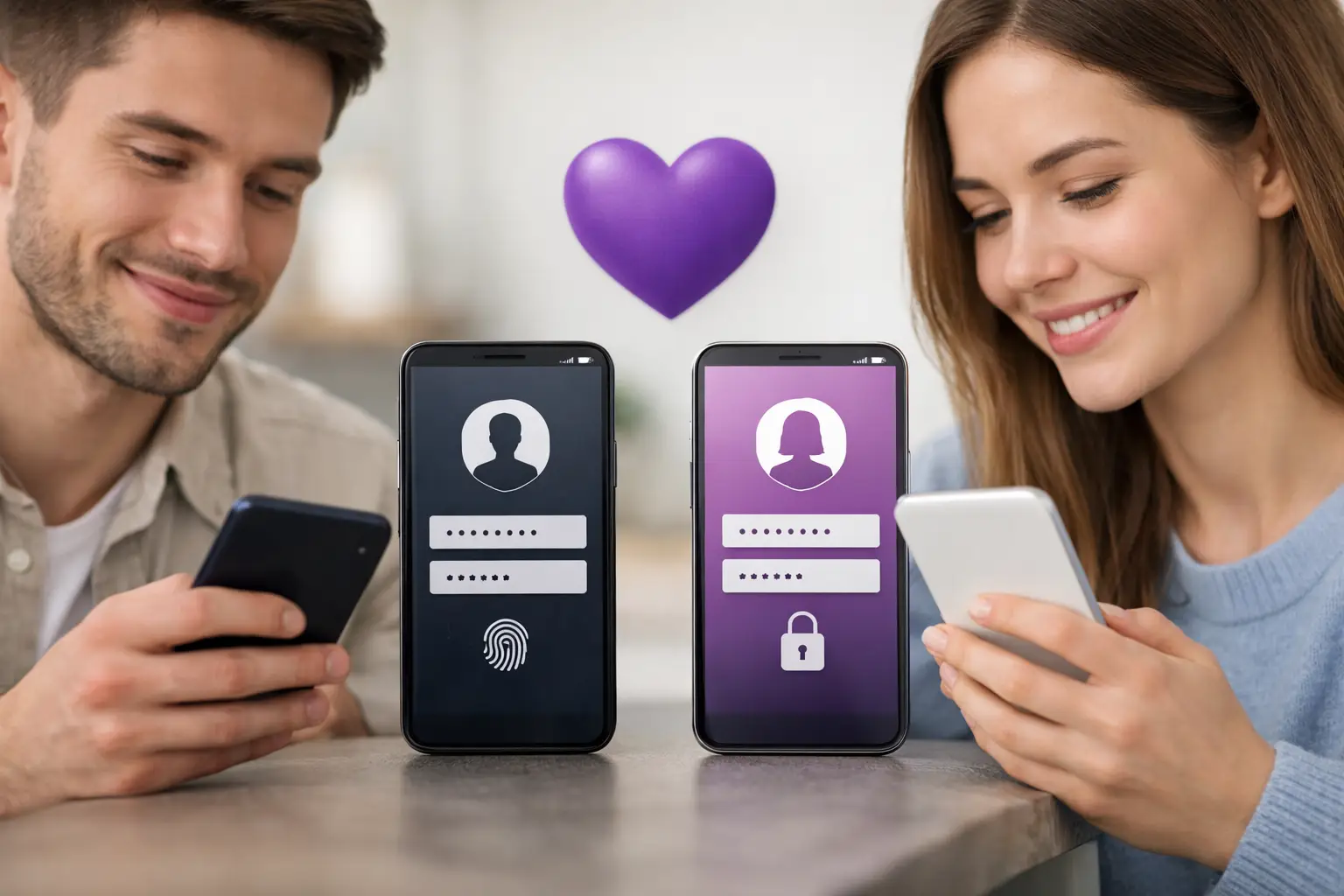
If you have ever shared one couple profile and found yourself asking, "Did you send that message or did I?" you already understand why couples dating app separate logins matter. For couples exploring the lifestyle, one shared inbox can create confusion fast. Separate access is not just a convenience feature. It is often the difference between clear communication and avoidable friction.
On mainstream dating apps, couple functionality is usually treated like an edge case. The account setup assumes one person, one identity, one inbox, and one set of preferences. That works poorly for couples, especially in adult spaces where trust, boundaries, and discretion matter more than almost anything else.
Why couples dating app separate logins matter
A couple account works best when both people can participate without stepping on each other. Separate logins allow each partner to access the same shared profile through their own credentials. That means both people stay involved, but the account still presents as one couple.
This solves a very practical problem. One partner may be more active in messaging, while the other wants to check conversations before meeting anyone. Without separate logins, the more active partner often becomes the unofficial account manager. Over time, that can create imbalance. One person ends up carrying the social labor, while the other feels less informed or less represented.
There is also a trust benefit. Separate access makes it easier for both partners to see what is happening inside the account without sharing passwords, passing around devices, or relying on screenshots. In adult dating, where misunderstandings can damage both comfort and confidence, that matters.
What separate logins actually improve
The biggest improvement is clarity. If each partner can log in individually, it becomes easier to stay aligned on conversations, plans, and boundaries. A couple can review messages together or separately, but both retain visibility.
This also helps with pace. In many couples, one person prefers to browse and chat more often, while the other takes longer to warm up. Separate logins let each partner engage at their own speed without locking the other out of the process. That can make the experience feel more respectful and less pressured.
Privacy is another reason this feature carries more weight than it may seem. Shared credentials are messy. They tend to get reused, stored in notes apps, or sent over text. Separate logins reduce that exposure. Each person can secure access on their own device while still participating in the same couple presence.
Then there is the issue of authenticity. Other users usually want to know they are speaking with a real couple, not one person running a couple profile alone. Separate participation can support that credibility. When both people are visibly involved in the process, interactions often feel more transparent and more serious.
Where one shared login falls short
A single login may sound simple, but in practice it creates blind spots. Password sharing is the obvious issue, but it is not the only one. The deeper problem is that one login turns a two-person dynamic into a one-door system.
That can affect everything from scheduling to consent. If one partner is chatting and the other has not seen the exchange, details can get lost. Expectations may be set too early. A meeting might sound more confirmed than it really is. None of that necessarily comes from bad intent. Often it is just poor account design.
It also places pressure on couples to create their own workarounds. They text screenshots, share devices, or set informal rules about who can message and when. Workarounds can function for a while, but they are still workarounds. On a platform built for couples, users should not need to patch over a structural problem.
Couples dating app separate logins and trust
In lifestyle dating, trust is not a marketing extra. It is part of the product. People are making decisions about privacy, identity, sexual compatibility, and personal safety. Features that support transparency inside the relationship are just as important as features that support safety outside it.
Separate logins help on both sides. Internally, they reduce the risk of miscommunication between partners. Externally, they signal that the platform understands how real couples actually use these services.
That does not mean separate logins fix every couple dynamic. If partners have very different expectations, no feature can solve that by itself. But good account design can reduce friction. It can make honest communication easier instead of harder.
For many users, that is especially relevant in adult networks where discretion matters. A couple may want one shared profile visible to others, but they still need personal control over how they access it. Those are not conflicting goals. They are both part of a well-designed trust model.
What to look for beyond separate logins
Not every platform that offers couple accounts handles privacy well. Separate access is useful, but it should sit inside a broader system built around discretion and verification.
A strong couple platform should make room for both shared identity and individual security. That usually means account access that does not require password sharing, profile tools that let couples present themselves clearly, and messaging that supports mutual awareness without chaos.
It also helps when the platform takes verification seriously. In adult dating, fake profiles and vague identities are not minor annoyances. They waste time and create risk. If a site supports couple accounts with separate logins but does nothing to establish who users actually are, the feature loses some of its value.
The same goes for privacy controls. Blurred photos, limited location precision, hidden identifiers, and careful handling of user data all matter. Separate logins answer one part of the safety question. They are strongest when paired with systems that protect the account and the people behind it.
Why this matters more for adult and swinger platforms
Lifestyle dating has a different pressure profile than standard dating. Couples are not just evaluating attraction. They are managing shared boundaries, discussing risk, and protecting a private part of their lives that may not be public offline.
That is why generic app logic often fails here. A mainstream platform may allow a couple to create a profile, but that does not mean the experience is designed for couple participation. Adult platforms that understand this space tend to build from a different starting point. They recognize that discretion, verification, and dual participation are not nice additions. They are baseline requirements.
That is also where a platform like Aphrodite.is fits naturally. Its couple-oriented account design, privacy controls, and verification focus reflect the reality that adult social connections work better when both trust and discretion are built in from the start.
Is separate login always necessary?
For some couples, maybe not. If one partner is clearly the primary user and the other only wants occasional visibility, a shared setup may feel manageable for a while. But even then, separate logins usually age better. They leave room for both people to participate more fully later without rebuilding habits around one person controlling the account.
It also depends on how a couple communicates. Highly organized couples with strong routines may tolerate a less flexible account structure. Couples who are new to the lifestyle, still refining boundaries, or balancing different comfort levels usually benefit more from features that keep both people informed.
So the question is not just whether separate logins are necessary. It is whether the platform respects the fact that a couple account represents two adults, not one user with a plus-one.
The better standard for couple accounts
A good couple profile should not force partners to choose between shared presence and individual control. That is the core issue. Couples need a way to appear as one account to the outside world while maintaining secure, transparent access on their own terms.
When a platform gets that right, the whole experience feels calmer. Messages are easier to track. Decisions are easier to make together. Boundaries are easier to maintain. And other users can engage with more confidence because the profile feels like it reflects a real, participating couple.
If you are comparing adult platforms, this feature is worth treating as more than a technical detail. In practice, it shapes how safely, clearly, and confidently you can use the service. For couples who value discretion and equal participation, separate logins are not a bonus. They are a sign that the platform understands the relationship behind the profile.
The best adult spaces tend to feel quieter, clearer, and more intentional from the first interaction - and account design is often where that starts.